DO-254
Practical DO-254 for FPGA Engineers
Why effective training must connect the objectives of the standard with engineering decisions, life cycle activities, and project evidence.
- Author
- AeroDAS Engineering Team
- Reviewed by
- AeroDAS Technical Review
- Published
- Last reviewed
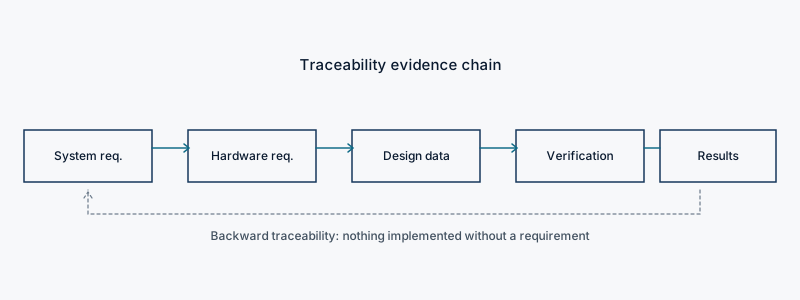
Engineers new to DO-254 often meet it as a list of objectives to be satisfied. That framing makes the standard feel like paperwork bolted onto engineering work that was going to happen anyway. It also produces the most common failure mode we see: a project that can point to a document for every objective, but cannot show that the documents describe what the hardware actually does.
What the standard is actually asking for
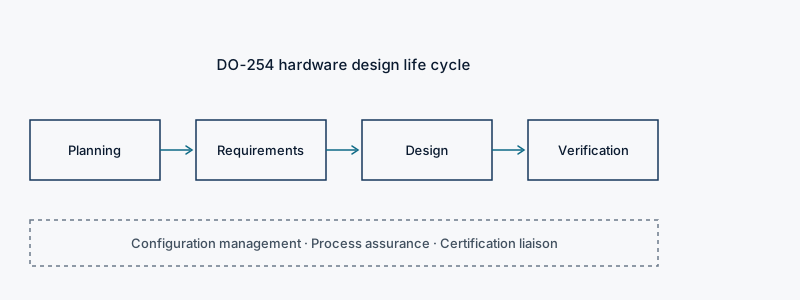
DO-254 describes a design assurance life cycle for airborne electronic hardware. Its objectives concern planning, requirements capture, conceptual and detailed design, implementation, verification, configuration management, process assurance, and certification liaison. The objectives are not a document list. They are a description of the engineering discipline expected of a team whose hardware can contribute to a failure condition on an aircraft.
The practical consequence is that evidence is a by-product of doing the work well, not an artefact produced afterwards. A requirement that was written to justify a design decision already made is not traceability; it is documentation of a conclusion.
Where FPGA projects diverge from the textbook
FPGA development compresses several life cycle activities into tooling. Synthesis, place and route, and timing closure make decisions that a reviewer will later want to see justified. Design assurance level drives how much of that must be substantiated, and at the higher levels the question of whether verification was performed on the implemented device rather than only on a simulation model becomes central.
- Derived requirements emerge from implementation choices and must be fed back for safety assessment, not recorded silently.
- Tool assessment and, where required, tool qualification apply to the tools whose output is not independently verified.
- Verification independence expectations tighten as the design assurance level rises.
- Elemental analysis or similar techniques may be needed to show verification completeness at the highest levels.
What effective training changes
Training that recites objectives produces engineers who can name them. Training that connects each objective to a decision the team will actually face produces engineers who recognise when a project is drifting away from a defensible position. The difference shows up at the first stage of involvement review, when a reviewer asks why a particular verification result is sufficient evidence for a particular requirement.
The useful question is not whether an objective has been addressed, but whether an informed reviewer would accept the evidence offered for it.
AeroDAS structures its DO-254 programs around that question. Concepts are introduced alongside the work products they govern, and exercises ask participants to judge whether specific evidence would survive review rather than to reproduce definitions.
“Engineering excellence begins where minimum compliance ends.”
Topics
- certification readiness
- DO-254
- life cycle data
- training